 The Book
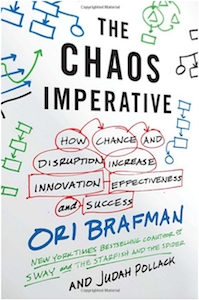
Ori Brafman and Judah Pollack, The Chaos Imperative: How Chance and Disruption increase Innovation, Effectiveness and Success, Crown Business, New York, 2013.
The Backstory
This book is inspired by Ori Brafman’s experience as a consultant to the US Army.
Traditionally, the military has been highly regimented and tightly controlled through the layers of hierarchy. Mostly, people were either giving orders or given orders.
This is highly effective in battle situations and a disaster for creating innovation and dealing with change. Brafman’s challenge was to bring some chaos and disruption to the Army.
Fresh and Intriguing
One of the great challenges for the author of today is to come up with a fresh and insightful set of stories to illustrate your point of view.
There’s nothing worse that reading a book (or listening to a keynote presenter) that is parlaying a series of stories that you’ve heard before.
This book is a great read because it’s filled with wonderfully fresh stories and mostly about Brafman’s time with the Army.
[Tweet “The Chaos Imperative by Ori Brafman #bookreview”]
The Five Rules of Chaos
Brafman and Pollack offer five rules for creating chaos in your organization:
- Avoid the Seductive Lure of Data and Measurement
- Remember, it’s called Organised Chaos
- Make White Space Productive
- Embrace Unusual Suspects
- Organise Serendipity
The Highlight
The highlight of this book for me was the chapter on The Neurobiology of Insight. We shared about this here. This is a groundbreaking insight. It updates the thinking on how our brains work and the good news… it shows that downtime is crucial for innovation.
Who should read this?
This book is for anyone working in or with an organization that is stuck in a rut or wanting to innovate. Be warned, the ideas are intended to cause the disruption needed to change your future course.