 Derived from…
Adam L Penenberg, Viral Loop
PROFIT : The key to multiplying your customers is to have positive feedback loops. It starts with someone liking you or your product and telling someone else. Referring one-by-one is useful, however opening up a decentralized referral system has the potential to explode and go viral.
Feedback loops
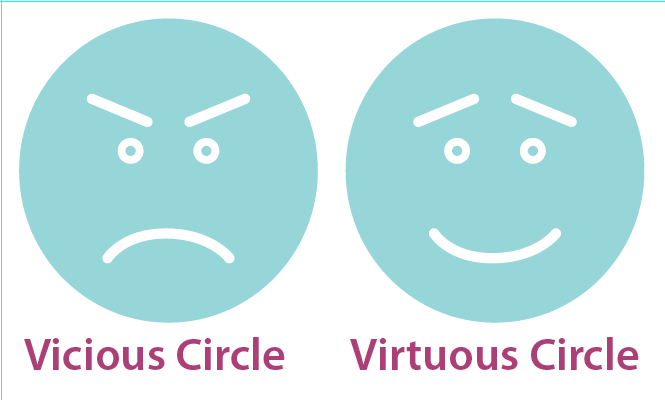
A negative feedback loop or a vicious circle occurs when one one undesirable thing leads to another and then another.
In contrast, with a positive feedback loop or virtuous circle things get better and more desirable with each iteration. A classic example is compound interest. If you leave your money in an account you’ll get paid some interest. Leave the interest there and soon you’ll get interest on your interest.
Take a dollar and double it every day for 30 days and you’ll have over $536 million! Now that’s viral growth!
Compare that to the traditional way of seeking referrals one at a time… Effective, albeit a little slow.
Viral Loops
The word ‘viral’ has been borrowed from epidemiology. It explains how things spread.
When it’s applied intentionally it can bring exponential results both negatively (a computer virus) and positively (Susan Boyle on YouTube).
The key to building a viral loop referral system is to design replication into your business model.
This is a shift from ‘what will happen’ to ‘how it will happen’.
Action : Ask yourself these three important questions…
- How is your business going to grow?
- How are your customers going to spread the word?
- And, the big one… What is built-in to your business model that enables your business to grow by itself?