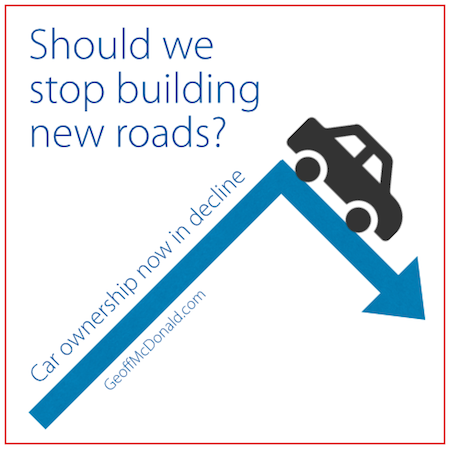
Do we need to keep building new roads?
For the first time car ownership is now in decline. New car sales per person are now at their lowest levels for 20 years having dropped significantly since the GFC – a trend that is appearing across the world.
For the Baby Boomers the car was a status symbol, an essential part of growing up and being mobile.
Today, mobile means something very different.
Gen Y and Millennials are happy without a car. Fewer are buying one and many are not even bothering to learn how to drive. And why would they? Who needs a car when your friends are already and always available in your pocket? All we need is some charge in our smartphones.
[Tweet “Is it time to stop building more roads? #oldfuture #generationalshift #digitalshift”]
This reflects not only a generational shift. It’s a digital shift too. It’s part of the transformation from the Industrial world of moving physical things to the Information world of shifting bits and bytes. The virtual is faster, easier and cleaner than any car will ever be.
What does this mean for the future?
- Do we need more roads?
- Is PM Abbott paving the wrong future for Australia?
- At what point do we stop building roads and start building better broadband?
- And, what is the future for all car manufacturers?
Source
Mike Clay, Is it the end of the road for Australia’s love affair with the car?; 7:30, Australian Broadcasting Corporation, 20/11/2014, http://www.abc.net.au/7.30/content/2014/s4133094.htm