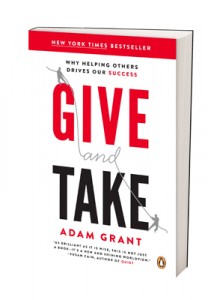
 In this podcast episode I’m sharing a book that I’ve recently read and have been telling everyone about. It’s been a real eye-opener for me as it describes one important aspect of who I am and how that helps me be successful plus it points out where I often fail.
And, whilst there are thousands of books on the topic ‘What does it take to be successful?’ this book flips conventional wisdom and presents a unique and surprising perspective.
Our Topic: Adam Grant, Give and Take
The book is called: Give and Take – A Revolutionary Approach to Success. The author is Adam Grant. He’s a Wharton Business School Professor and Organisational Psychologist.
[Tweet “This #book by @AdamMGrant feels like the missing link in my career #giveandtake”]
 In this Podcast Episode
 In this Podcast Episode
- Learn the difference between a giver, taker and matcher
- Find out why the giver is the least successful style
- Find out which style is the most successful
- Discover which reciprocity style is prone to faking it
- Find out ways to give more generously
- Find out ways to protect yourself as a giver
- Learn how a Reciprocity Ring could transform networking events
 Know the secret of the five-minute favour
 Know the secret of the five-minute favour
Show Links
- The book website – includes a 5 minute 15 question profiling tool to find out your preferred style (see my example above). You can also download Chapter 1 for free.
Listen, Download, Share
Podcast: Play in new window | Download | Embed
Subscribe: RSS