 Derived From
James Surowiecki, Wisdom of Crowds
PROFIT : Are you good at making decisions? Be careful, that’s a trick question… Even if you’re really, really good at making decisions you may be surprised to know that a crowd will consistently out perform you. Here’s how…
Collective Wisdom
If you simply ask enough people then average out their responses, statistically they will consistently be more accurate than any individual.
Normally when we average out a group of people we are left with mediocrity. With decision making if we average out the errors we are left with the key information and often excellence.
The key to collective wisdom is the deep and varied knowledge used to come to a decision. Each person can add a different perspective and when added together can provide a fuller picture.
As an individual expert no matter how smart we are, we are always limited by what we can know.
By definition our expertise is always narrow; as individuals our performance will vary from one day to the next. And, our fatal flaw is the Confidence Paradox. We need to be confident enough to believe in our ideas and not too confident to pretend that we have all the answers.
Everyday Examples
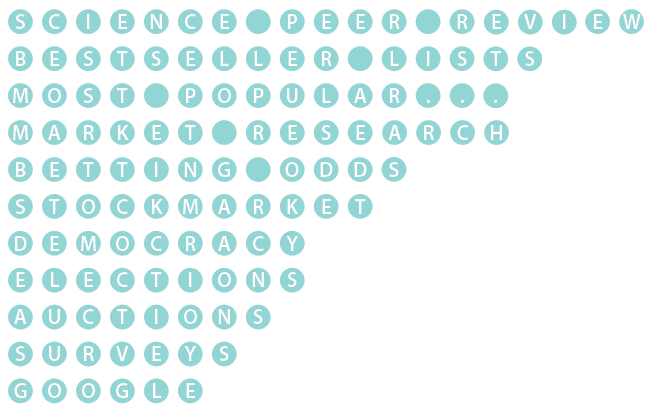
The Stockmarket
How much should a share in a company be worth? There are many different viewpoints on this depending upon your model. The stockmarket defines today’s market prices through the thousands of investors who buy and sell. This is the wisdom of the crowd at work.
Google
Google’s secret for returning useful search results in a matter of seconds is their automation of the collective wisdom of all web surfers. Each web page they review is ranked according to a range of factors including their popularity. This is based upon the number of links to each page. The presumption is if more people are linking to a particular page then that page is a popular page and more likely to be what you are also looking for.