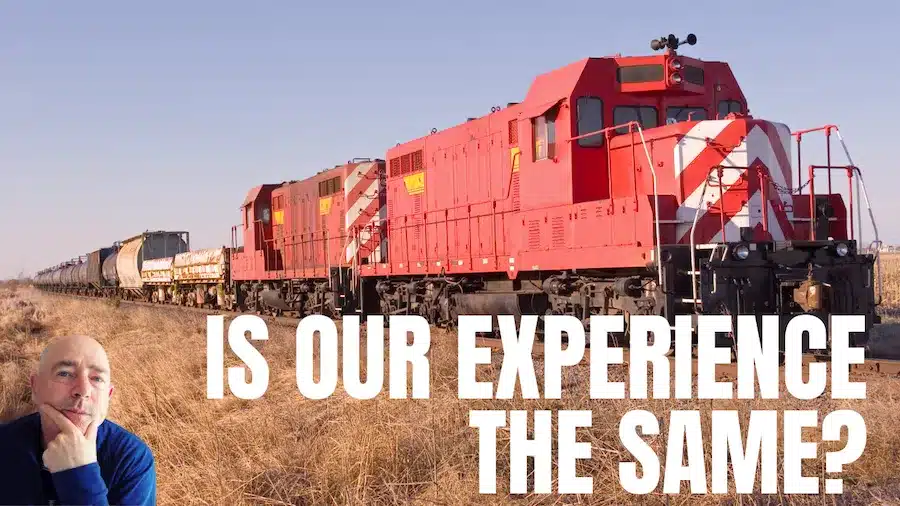
When two people are standing side-by-side watching the same event, is our experience the same?
My brother loves trainspotting. And to be honest, I never understood why.
Unlike birdwatching, where you never know what species you’ll see, trains are predictable. They run on tracks and they run on timetables. This means you know where they will be and when they’ll be there.
That’s why I thought trainspotting was the world’s most boring hobby. Here comes the train, there goes the train. You take a photo and you go home. Where’s the excitement in that?
That all changed when I asked him why he enjoyed it.
Are we looking for the same thing?
The big surprise was that he wasn’t really interesting in watching the train, he wanted to hear them.
And not at any random point in their journey, but in the moments of transition. For instance, as they pulled away from a station, climbed a big hill or rolled to a stop.
His interest wasn’t in what the train looked like, but what the engine was doing. When he said that, it all made sense.
How our unique history shapes us
My brother had spent years as a mechanic in the army, working on everything from cars to tanks. Before that, he had learnt to play the trumpet and played in brass bands.
Those two experiences had come together in a unique way.
For me, the train was just making noise. But, he heard a machine under load, and specifically, he was listening for changes in power.
If we stood together beside the same railway line, we’d both see the same train and hear the same sounds. But we wouldn’t be having the same experience.
How your Experience changes what you notice
The train hadn’t changed, but my brother had. His experience had changed what he could notice.
This made me realise I had misunderstood my brother and his experience.
Our experience gives us more knowledge, but also something more valuable.
Our experience changes our perception. We start to gather distinctions about what is going on around us and this expands our understanding of life and work.
A designer notices relationships.
A mechanic hears an engine.
An anthropologist notices cultural rituals.
A mindfulness teacher notices thoughts.
A football coach sees patterns of play.
I thought I knew what my brother was experiencing until I realised we weren’t experiencing the same world.
This is why experience fascinates me. It doesn’t just help us solve problems, it also changes the world we experience.
While I see trains, my brother hears them.
What has your experience taught you to notice that others often miss?
More Field Notes
This is Field Note #6. Field Notes are observations from my ongoing enquiry into experience. To learn more about how to make the most of your experience, read these posts next: