We often think experience accumulates into value automatically. But Rambo shows it doesn’t work that way.
I recently rewatched Rambo: First Blood.
Like many action films from the 1980s, it’s filled with explosions, car chases and classic one-liners. I’ve probably seen Rambo four or five times. This time I started watching for some easy entertainment, but I soon started to notice it was saying something interesting about experience.
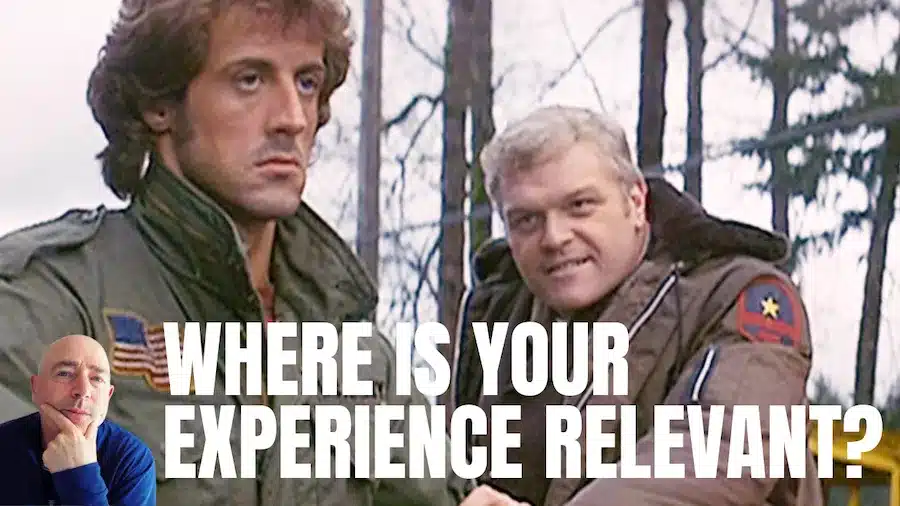
John Rambo (played by Sylvester Stallone) is a decorated Green Beret returning from the Vietnam War. At the start of the film, he learns that the last surviving member of his unit has died. He’s grieving from his mate’s death and still carrying scars from the war.
Then he wanders into a small country town and the local sheriff takes one look at him and decides he’s trouble. Without asking a single question, he literally drives Rambo out of town.
What follows is one big misunderstanding.
The Right Experience
The sheriff’s experience has taught him to protect his town by recognising potential threats. But this time he gets it wrong. He doesn’t see Rambo as a grieving war veteran but someone who triggers a memory or a pattern from his own past. His experience, in this moment, has hardened into a fixed judgement.
Everything changes once the confrontation moves into the mountains.
The local police know the bush well because they’ve hunted deer out there for years. Then the National Guard arrives. They look the part, but as one soldier admits: “I do this part time. I’ve got to be back at the drug store tomorrow.” They have experience in this location, just not this kind of experience.
Rambo, by contrast, has been trained for survival, tracking, camouflage and guerrilla warfare. What seemed like one man against many turns quickly. One of the deputies has a sudden realisation: “We ain’t hunting him… he’s hunting us.”
The experience that seemed irrelevant in town becomes decisive in the forest.
Understanding Other People’s Experience
The only person who understands what’s happening is Colonel Trautman, Rambo’s commanding officer from the war. He tells the sheriff: “I didn’t come to rescue Rambo from you. I came here to rescue you from him.”
Trautman can see the situation through Rambo’s eyes because he shares enough of Rambo’s experience to understand what it produces. While everyone else wants to capture Rambo, Trautman wants to defuse the situation. Two people, looking at the same reality, and seeing something completely different.
At the end of the film, Rambo breaks down and cries. And for me, watching the movie this time around, it’s the moment that had the biggest impact.
Rambo doesn’t lack experience. He has more than almost anyone around him. But he can’t translate it into the world he’s come home to. His experience gave him status and capability in one context but left him isolated and invisible in another. It no longer fits the situation he’s in.
When Experience Becomes Valuable
We often think experience accumulates into value automatically. But Rambo shows it doesn’t work that way. Experience only becomes valuable when it fits the context.
This is something many experienced professionals know internally but rarely name. You’ve spent years, maybe decades, developing real expertise. Then something shifts. Your industry changes. AI arrives and reshapes what competence means. You move into a leadership role and discover that what made you exceptional as a practitioner doesn’t automatically make you effective as a leader. You start your own business and find that the credibility you built inside an organisation doesn’t continue with you the way you expected.
Your experience hasn’t disappeared. It just hasn’t been translated yet to fit the new situation.
Rambo in the jungle and Rambo in the town are the same person with the same history. The difference is context. And the real work is learning to read which of your experiences matter most in the situation you’re actually facing.
Your challenge isn’t to accumulate more experience; it’s to learn where the experience you already have is most valuable.
What context is your experience most useful for? And least useful?
More Field Notes
This is Field Note #7. Field Notes are observations from my ongoing enquiry into experience. To learn more about how to make the most of your experience, read these posts next: