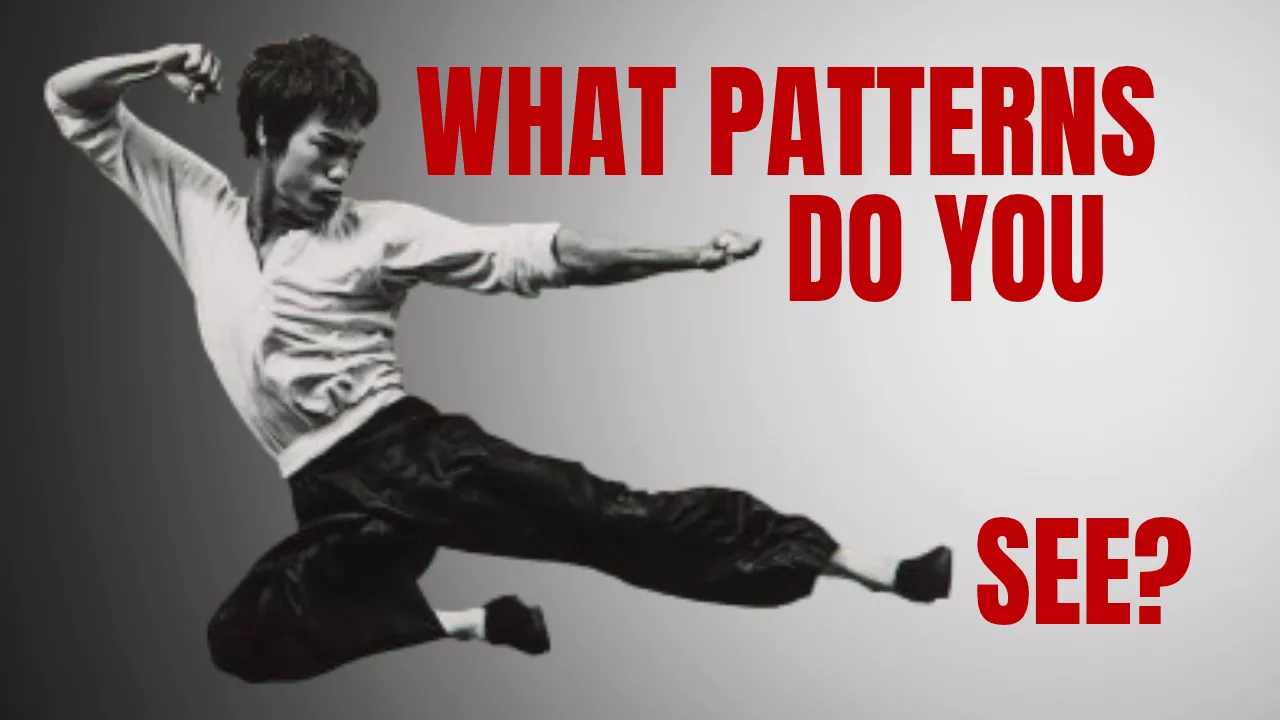
Traditional martial artists spend years perfecting a punch. Bruce Lee became fascinated by something else.
He stopped concentrating on the actual punch and became fascinated by what created a punch.
At first, that sounds like a small shift. But, I don’t think it is.
Traditional martial artists trained in techniques. They drilled the same punch 10,000 times until it looked perfect in a mirror.
But Bruce thought this was the wrong question. Instead, he asked, ‘what made a punch deadly in the first place?’
He focused on two things: speed and power.
Instead of training his technique he trained these two attributes. He figured if you build those qualities first, then the technique would follow.
But throwing a punch in a fight is only half the battle, you also have to defend against them. And this is where Bruce had a challenge.
Bruce was medically unfit for the US Army due to poor eyesight. This made it difficult to read a punch and would’ve forced most martial artists to quit.
But, Bruce stopped trying to read punches and started reading bodies. He looked for the shoulder drop, the transfer of weight and the rotation of the hips.
He wasn’t just seeing more detail, he was now seeing the punch before it was released.
Most beginners notice events. They see a punch.
But an experienced martial artist notices patterns. They see the movements that lead to certain attacks.
Bruce learnt to see the structure creating those patterns. He was noticing balance, timing, coordination and intention.
Bruce no longer saw punches, he saw the body preparing to punch.
This might be what experience actually does.
A doctor sees behaviour before disease.
A designer sees intention before products.
A mindfulness teacher sees our relationship to experience before stress.
An anthropologists sees culture before behaviour.
Experience doesn’t simply help us respond better to events.
It shifts our attention towards the structures that create them.
While some people become very good at recognising familiar events, others keep asking, ‘What keeps producing this?’
And every time they discover another structure, their perception expands and their experience deepens.
Bruce Lee became famous because of how fast he could throw a punch.
But perhaps his greatest achievement happened long before he ever threw it.
He had learned to see the punch before it existed.
Perhaps this is what experience has been teaching us all along.
It’s not to react faster or remember more, but to shift our attention from events to patterns and structures.
What patterns do you see that others may not?
More Field Notes
This is Field Note #20. Field Notes are observations from my ongoing enquiry into experience. To learn more about how to make the most of your experience, read these posts next:
- What Travel taught me about Experience
- What Dementia taught me about Experience
- What Mick Jagger taught me about Experience