The emotions of innovation are often either a missing or misunderstood part of the innovation process.
The Role of Emotions
My book of the year for 2019 was David De Steno’s book, Emotional Success. He is a researcher into our emotions.
In Emotional Success, he talks about how our emotions set up our future actions. Our brains are constantly scanning our environment for potentially life-threatening situations. And in response to this, they trigger an emotional response. The extreme form of this survival mechanism is flight, fight or freeze. In other words, whenever we face a threat we either shape to fight it head-on, run away from it or stand and stare at it like a deer in the headlights of a car.
As we mentioned in the post ‘Unlock the super simple secret to innovation work‘, the emotions that we generate can promote the behaviour we want or not. It all depends upon how we perceive the situation we are facing.
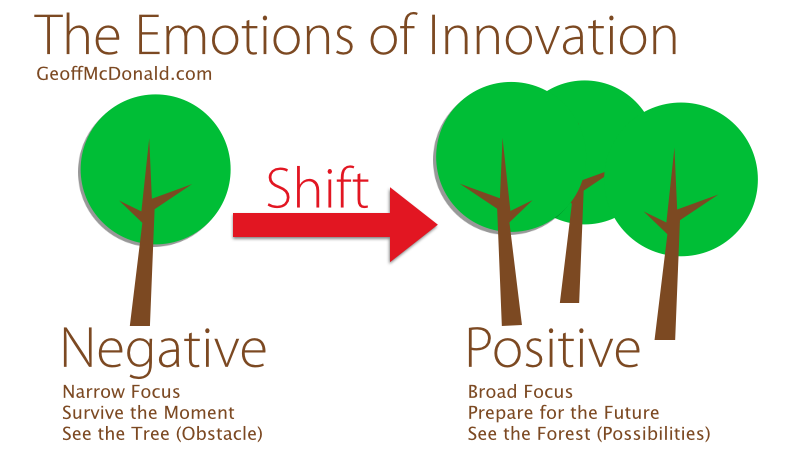
The Emotions of Innovation
Daniel Pink in his fabulous book To Sell is Human shares the work of Barbara Fredrickson (P105). It provides a powerful and critical view to the emotions of innovation.
While the notion of positive and negative emotions is a little simplistic, it is a useful frame for viewing our actions.
Our negative emotions are highly useful for specific situations. They have evolved to narrow people’s focus and drive their behaviour to survival by focusing on the specific obstacle that is stopping or threatening us at that moment. It’s seeing the trees!
In contrast, our positive emotions have a wider focus on the possible thoughts and actions we could take in the future. It’s seeing the forest!
To be truly innovative we need positive emotions otherwise we’re just reacting to the roadblock and not considering the full range of options.
Knowing how to manage and shift emotions is therefore crucial for creating innovation.
[Tweet “The Emotions of #Innovation – see the forest not the trees”]