One of the most common worries I hear from experienced professionals is this:
- My experience is too broad.
- I’ve done too many things.
- I should have specialised more.
And almost every time, that’s not the real problem.
I know this one well. Because for a long time, I saw myself the same way.
My Career and the Shame of Breadth
I’ve always been a generalist.
While some people have had 9 jobs, I’ve had 9 careers.
(Architect, website design, instructional design, sculptor, corporate trainer, business coach, book summary writing, author, speaker)
I moved across roles, industries, and ways of thinking.
For years, that felt like a liability.
I remember meeting with a recruitment agency that told me to cut large parts of my résumé.
Not because they weren’t true, but because they’d be “too confusing” when applying for jobs.
My career didn’t fit a neat label.
It didn’t point to one obvious box.
And compared to specialists with a single, clear lane, mine felt… messy.
Not because it lacked value.
But because I didn’t yet have language for what that breadth was actually doing.
Why specialisation isn’t the only path
Here’s the mistake we make.
We assume that depth only comes from narrowing.
That focus means choosing one thing and excluding everything else.
But that’s not how value works in complex environments.
What Range reveals about generalists
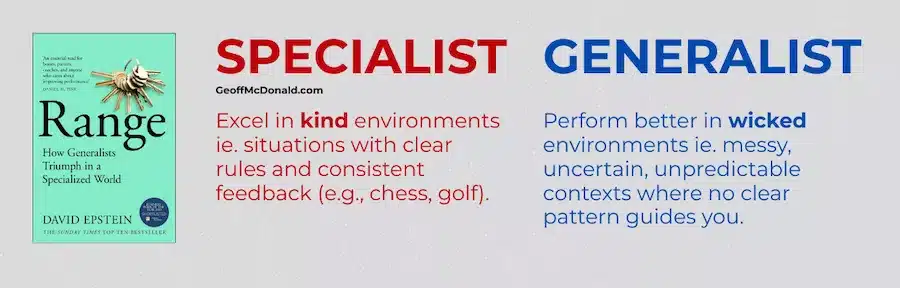
This is exactly why David Epstein’s book Range resonated so strongly with me.
His research showed that in complex, fast-changing worlds, the people who thrive aren’t always narrow specialists.
They’re often generalists.
People who can:
- Transfer ideas across domains
- See patterns others miss
- Make connections between seemingly unrelated things
In other words, the more complex the world becomes, the more valuable range becomes.
That’s not a weakness. That’s an advantage.
The Lego metaphor: Pieces vs The Model
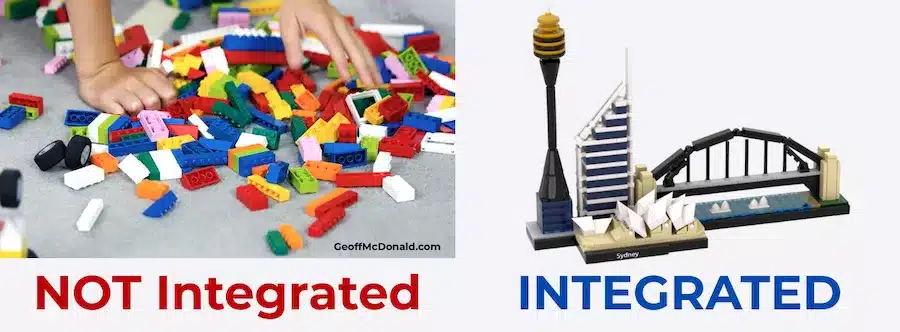
Think of your experience like a box of Lego.
Inside the box are lots of different pieces. Different shapes. Different colours. And different sizes.
If you pour them all out on the table, it can look chaotic. Unconnected. Hard to explain.
But the problem isn’t the pieces.
A box of Lego isn’t a mess. It’s raw material.
The value doesn’t come from staring at the pieces individually.
It comes from the model you build with them.
And once you’ve built a model, you can rebuild it again. In different contexts. For different problems. With different people.
That’s what experienced professionals actually do.
They don’t just bring skills.
They bring structures of thinking that travel.
Why integration is the real work
This is the shift most people miss.
Breadth isn’t the problem. Lack of integration is.
The real work at this stage of your career isn’t narrowing yourself down.
It’s stepping back and asking:
- What patterns connect these experiences?
- What problems do I keep solving, regardless of context?
- And what’s the underlying model I keep rebuilding?
Most people think this is a confidence problem. It isn’t. It’s a design problem.
And once the design is clear, confidence tends to take care of itself.
Where Monetising Broad Experience Begins
This is also where monetising your expertise really begins.
Not by cutting pieces away. Not by pretending parts of your career didn’t happen.
But by integrating what’s already there into something coherent, repeatable, and valuable.
So if your career feels too broad, pause. Nothing is wasted.
The value isn’t the pieces. It’s the model you can rebuild.
And once you see that model clearly, everything else starts to line up.
More on How to Monetize Your Expertise
If you want to dig deeper on how to monetize your expertise then read these posts next: