If you have 20 or 30 years of experience and you still can’t explain what you do in one clear sentence, the problem isn’t you.
It’s not that you’re unfocused. It’s not that you’re behind. And it’s definitely not that you lack value.
The real problem is this: You’re trying to describe your work from the wrong position.
And I know what it’s like to struggle to explain what you do. I spent years stuck there myself.
The Cathedral Problem: Why Experts Can’t See Their Own Expertise
Imagine you’ve spent decades helping to build a cathedral. You’ve worked on the foundations. You’ve added arches, repaired walls, and redesigned rooms. And you know every stone because you’ve touched most of them.
Now someone walks up and says, “So… what is this place?”
And you start answering like this: “Well, there’s limestone here, and mortar there, and these bricks were laid in phases, and this section was renovated in 2008…”
You’re not wrong. But you’re also not clear.
Because you’re standing inside the cathedral, listing bricks, instead of stepping outside and seeing the whole structure.
That’s exactly what happens to smart professionals.
Why Skills and Job Titles No Longer Capture Real Expertise
The more experienced you become, the harder it gets to explain what you do.
Why? Because your value no longer lives in individual skills.
It lives in:
- Pattern recognition
- Judgment
- Knowing what not to do
- Seeing connections others miss
But none of that shows up neatly on a CV or in a job title.
So you default to describing tasks, roles, and history.
Not because that’s your value, but because it’s the only language you were ever given.
Why Simpler is NOT the Solution
This is important: Clarity is not simplification.
It’s integration.
You don’t need to shrink your experience down. You need to organise it.
Most senior professionals aren’t too broad. They’re just standing too close to their own work to see its shape.
Three Questions to Ask to Reveal Your Expertise
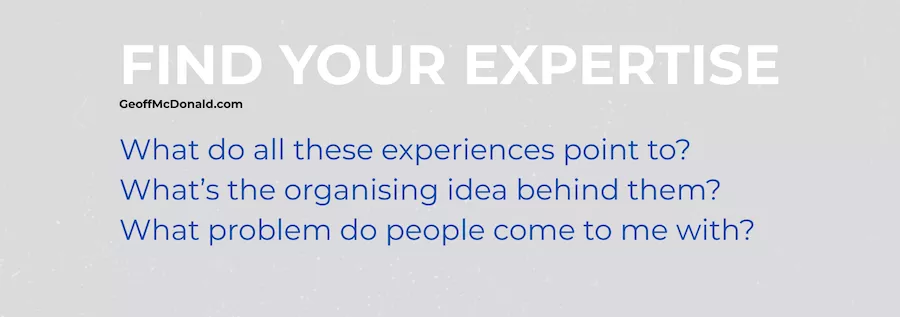
The real work at this stage of your career isn’t learning something new.
It’s stepping back and asking:
- What do all these experiences point to?
- What’s the organising idea behind them?
- And what problem do people consistently come to me with?
These are not skill questions. They’re sense-making questions.
My breakthrough came when I found a name for my work: The Ideas Architect. I used to be an architect, but I don’t design buildings anymore. I design ideas. That single phrase made sense of my entire career.
How to Monetize Your Expertise

When you find your organising idea, this is where monetising your expertise actually begins.
Not with:
- Niching down
- Rebranding yourself
- Or starting over
But with articulation.
Because once you can clearly explain the structure you’ve built, other people can finally see it too.
And once they can see it, they can value it, trust it, and pay for it.
So if you’re struggling to explain what you do, don’t panic. You’re not broken, and you’re not late.
You’re just still standing inside the cathedral. Step outside.
That’s where clarity lives. And that’s where everything else starts to make sense.
More on How to Monetize Your Expertise
If you want to dig deeper into how to monetise your expertise, then read these posts next: