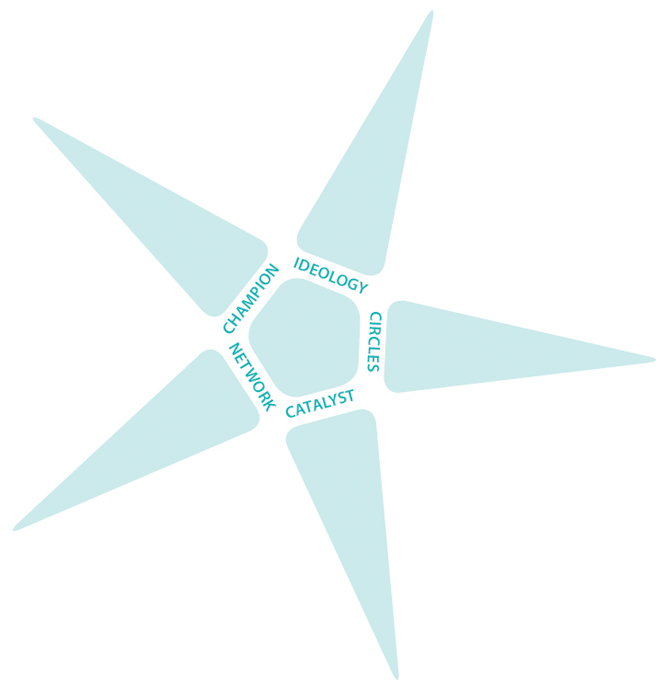
The Five Things You Need to Create a Decentralized Organization
Derived from…
Ori Brafman and Rod A. Beckstrom; The Starfish and the Spider
Previously
How Decentralization re-invented the Music Industry
RAP4: Five Legs
Just like the starfish, you can lose one or two of them and still function.
For best results, five legs working together are better than less.
Catalyst
A Catalyst initiates the project by creating and sharing the ideology, they lead by example and then fade into the background.
They let go of control and allow the organization to become it’s own entity.
A catalyst is like an architect who designs the organization but never moves into the finished building.
They give the users the power to decide and they transfer ownership and responsibility to the circle.
Champion
A starfish organization needs 2 types of people, the catalyst to get things started and the champion to implement.
The Champion is relentless in pursuit of an idea – they take it to another level.
They’re like a bull terrier with a bone – they just won’t let go.
A Champion will tell everyone about your idea, they’re a natural sales person.
Ideology
Why would you contribute to Wikipedia or Open Source software?
You don’t get paid – at least not in dollars.
Your reward is being part of a movement or forwarding an ideal.
Ideology is the glue that holds it all together.
What is your mission?
The ideology of Alcoholics Anonymous is represented by the 12 step process.
Virtual or online starfish organizations may have less dependence on an ideology because the commitment to join is less involved and this does not lessen its importance.
In a typical corporate environment where dollars rule, the commitment to shared values and common belief is less important.
Many corporates cling to misfired mission statements in the hope of lighting the fire of idealism in their employees.
Gen Yer’s in particular are not interested in this.
Give them something to truly believe in!
Circles
Small cells or independent and autonomous circles of members are the core of a decentralized system.
They need to be exclusive not open.
Once accepted you’re an equal member and expected to pull your weight and contribute to the best of your abilities.
In a physical setting, 14 is a useful rule of thumb for a cell size to maintain an effective bond.
In virtual or online cells, the number can increase although the bond will naturally be less.
When a circle becomes too big it enables free-rides or destructive behaviour.
Given there are no rules or power to enforce, personal responsibility and face-to-face accountability are crucial.
Trust is created by applying norms based upon standards, models or process.
Ebay feedback points are the marker of trust in their starfish organization.
Network
It may not be easy to start a physical starfish organization from scratch.
It’s much easier to piggyback on to an existing network or build an online viral organization via the internet.
Critical mass is important – the power of the network increases with each additional member.
Also, designing a meme or a way to pass on the ideals and values is critical to entice new participants.
In the short term, it is easy to rule top down giving orders and expecting members to follow.
Some will, some won’t.
Ultimately, this limits creativity and involvement which will strangle the growth of the organization in the long term.
A decentralized starfish organization is more open to innovation because it is not structured or attached to a fixed approach.
The adoption of new ideas versus force and power allows the network to grow more rapidly.
There was a period in my work when I knew I was helping people. Clients were…
Something has changed. You can feel it… even if you can't quite name it yet. Work…
You've probably had this experience. You've been doing good work for years. Clients are happy. Projects…
If you've been increasing your visibility and still feel unseen in a deeper way, this…
Most experienced professionals eventually move from producing insight to designing the structure behind their work.…
A lot of experienced professionals make important decisions at exactly the wrong moment. Not when…